
Written by
 Joshua Thompson
Article details
» 12 min read
The Video & The Deck
Video not loading? Watch on YouTube
📊 The State of Play for UK Business
The UK business landscape is in a state of dynamic tension. On one hand, we’re navigating high taxation, shifting sentiment, and a broader global reset. On the other hand, business confidence – at least among UK leaders – remains surprisingly resilient.
- Britain’s tax bill currently stands at approximately 37% of GDP – one of the highest levels in decades.
- There has been a notable exodus of millionaires – many citing tax and lifestyle motivations for leaving.
- Despite this, 83% of business leaders feel confident about their own company’s prospects.
- However, confidence in the UK as a wider economic landscape is more muted – many leaders feel more positive about other markets they operate in.
- In response to economic pressures, 44% plan to increase prices while 41% will focus on cutting internal inefficiencies.
This reflects a dual approach: businesses are raising prices where needed, but also trimming the fat and refocusing operations. Confidence is localised – within businesses themselves – even if macro sentiment is wobblier.
🌍 The UK – Still a Global Economic Power
6th Largest Economy in the World
Don’t let the headlines fool you. The UK remains the 6th largest economy globally. While growth has slowed and challenges persist, we’re still a powerhouse for business, innovation, and consumer spending.
Why the UK Still Matters:
- High consumer spending – UK consumers continue to spend on services, subscriptions, and experiences, making the UK a great testing ground for new ideas.
- Stable regulation – While red tape exists, the legal and regulatory system is relatively predictable, offering reassurance for founders and investors.
- A strong service-based economy – With finance, healthcare, tech, and professional services leading the charge, the UK economy is knowledge- and service-driven.
- A launchpad for global growth – The UK offers a controlled, English-speaking environment to test and refine business models before international expansion.
In short, while the cost of doing business has risen, so has the potential to scale efficiently if you build lean and stay sharp. The market’s still there – the winners will be the ones who adapt fast.
👵 Population Demographics: An Ageing Nation
The UK is undergoing a major demographic shift – and it’s opening up a wave of new business opportunities. With people living longer and birth rates falling, the population is skewing older. According to the Office for National Statistics (ONS), the number of people aged 65 and over is projected to rise to 22.1 million by 2072, making up around 27% of the population. That’s a huge increase from just 11 million in 2022.
This shift is being driven by a combination of increased life expectancy and the aging of the baby boomer generation. And it’s changing what people need – and want. For businesses, that means growing demand in sectors like:
- Healthcare – from private care services and home adaptations to digital health and telemedicine.
- Wealth management – older individuals often hold significant assets, creating demand for financial planning, pensions advice, and inheritance strategies.
- Lifestyle services – including wellness, travel, mobility, and leisure products designed specifically for an older, active audience.
Opportunities for UK Small Business
Businesses that can deliver products and services tailored to this evolving demographic – especially with empathy and simplicity – will be well positioned to thrive in the years ahead. The ageing population isn’t a challenge to be managed – it’s a market to be understood and served.
Small Business Basics
Ensure you are comfortable with the basics, by reading our UK Small Business Basics guide.
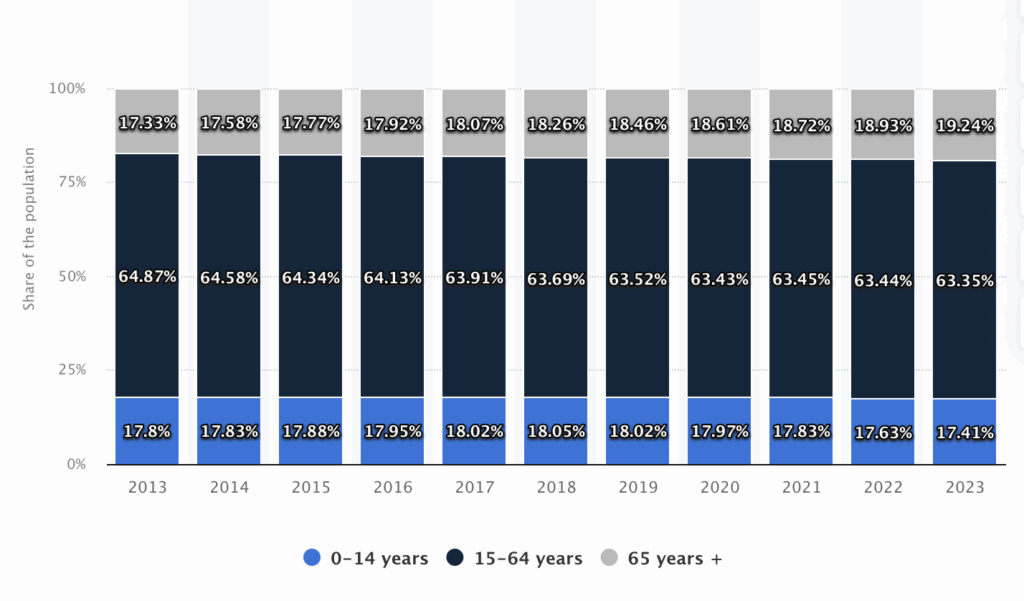
United Kingdom: Age distribution from 2013 to 2023
UK Small Business Growth Ideas
| Business Idea | Why It Works |
|---|---|
| Private Home Care Services | Increased demand for in-home assistance with daily tasks as people live independently for longer. |
| Digital Health Platforms | Apps or services offering virtual GP appointments, medication reminders, or health tracking for older users. |
| Mobility & Accessibility Products | Custom furniture, stairlifts, grab rails, and tech for safer home living. |
| Financial Planning & Retirement Advice | Support navigating pensions, inheritance, and managing later-life finances. |
| Travel Services for 60+ Market | Tailored holiday packages, insurance, and tours for active retirees. |
| Companion Services | Non-medical companionship to combat loneliness – can be virtual or in-person. |
| Home Downsizing Consultancy | Helping older people move to smaller homes with ease – including estate sales and removals. |
| Fitness & Wellness for Seniors | Specialist exercise classes, yoga, or nutrition coaching for over-60s. |
| Tech Support for Older Adults | Services to help seniors with smartphones, apps, or social media – with patience and clarity. |
| Subscription-Based Nutritional Meal Plans | Home-delivered meals tailored to specific health conditions or dietary needs. |
Standing out in UK Small Business
Despite the UK’s reputation for innovation, many small businesses still lag behind when it comes to digital presence, consistent branding, and customer communication. This creates a huge opportunity for new and growing ventures.
You don’t need a massive marketing budget or a viral campaign to stand out. In reality, just doing the basics really well already puts you in the top 10% of UK businesses.
🚀 Here’s what makes you stand out instantly:
- Clarity: Explain clearly what you do, who it’s for, and how to get started – across your website, socials, and email.
- Speed: Respond to enquiries quickly. Most businesses don’t reply at all or take days – be the one that answers in minutes.
- Consistency: Use the same tone, colours, and branding across every touchpoint. It builds trust, and trust leads to sales.
- Visibility: Post regularly, show your face, and share real results. Showing up online keeps you top of mind with your audience.
Trust is built over time – not with one big gesture, but with small actions done consistently. If you can be clear, responsive, and visible, you’ll already outperform 90% of the competition. It really is that simple.
🧠 Are You Working On or In the Business?
One of the biggest turning points in any UK small business journey is recognising the difference between working in your business versus working on it. Early-stage entrepreneurs often find themselves caught in the weeds – replying to emails, sending invoices, chasing suppliers – without stepping back to design the systems that drive long-term growth.
If you’re serious about scaling and creating a sustainable business that doesn’t rely on your presence 24/7, you need to shift gears. Working on the business means building infrastructure: repeatable processes, documented workflows, and a strategy that allows your business to grow without burning you out.
📋 Efficiency is Everything
In the world of UK small business growth, efficiency isn’t just a nice-to-have – it’s a competitive advantage. Time, money, and energy are your most limited resources as a founder. The businesses that win aren’t always the flashiest – they’re the ones that run lean, minimise waste, and get things done faster without sacrificing quality.
That means building habits and systems that cut friction. From your email templates to your onboarding flow, every touchpoint should be optimised to save time and improve consistency. A small tweak to a process you do 10 times a week can save hours – and those hours compound quickly.
⚙️ Real-World Efficiency Boosters
- Automate Repetitive Tasks: Use tools like Make.com, Zapier, or Google Apps Script to automate lead captures, invoices, and follow-ups.
- Use Templates: Create reusable templates for emails, proposals, contracts, and social posts to reduce rewriting and rethinking.
- Batch Work: Group similar tasks together – like content creation or admin – and complete them in focused blocks.
- Delegate Early: Don’t wait to be overwhelmed. Outsource low-value tasks so you can focus on strategy and growth.
💡 Efficiency Fuels Growth
When your business runs efficiently, you unlock the ability to grow without chaos. You deliver faster, respond quicker, and build a better customer experience. That’s what sets you apart in a crowded UK market – not just what you do, but how seamlessly you do it.
Remember: efficiency isn’t about doing everything. It’s about doing the right things, in the smartest way possible.
🚀 Why It Matters for UK Small Business Growth
The most successful small businesses in the UK don’t grow by doing everything themselves – they grow by building systems. When you step back to systemise and document, you give yourself the freedom to think strategically. That’s when you find the time to launch new products, enter new markets, or finally take that overdue break.
In a competitive landscape, systems are your edge. They reduce errors, improve customer experience, and make scaling achievable – without sacrificing your sanity.
The Shell Manual
The perfect SOPs for UK growth.
If you had to hand your business to someone else for a week, could they run it without you? That’s the question at the heart of the Shell Manual. For UK small business owners looking to scale sustainably, Standard Operating Procedures (SOPs) aren’t just helpful – they’re essential. Think of them as your business’s instruction manual, enabling you to delegate with confidence, reduce reliance on memory, and future-proof your operations.
In the early stages, everything lives in your head – but that doesn’t scale. As you grow, you need clarity, consistency, and a way to train new team members quickly. That’s where the Shell Manual comes in. Build your business as if you were preparing to license or franchise it. Document your key workflows, decisions, and responsibilities in a simple, repeatable format.
🧱 What to Include in Your Shell Manual
- Client onboarding process: From enquiry to invoice – what happens and when?
- Sales and outreach: Email templates, follow-up flows, lead tracking.
- Daily and weekly routines: From social media posting to admin tasks – systemise your rhythm.
- Emergency procedures: What if a website goes down or a client misses payment?
- Finance & reporting: When and how do you reconcile, pay VAT, or check cashflow?
📂 Tools to Build It
You can start with a simple Google Doc or Notion template. As you grow, consider using platforms like Trainual or Scribe to create interactive walkthroughs and visual SOPs. The key is that your documents are easy to update and accessible to those who need them.
Tip – Any software you use that has Webhooks built in, means you have a trigger to access data.
📈 Why It’s a ‘hack’ for UK Business Growth
Whether you’re hiring your first contractor or scaling up to multiple team members, the Shell Manual helps ensure your standards and culture are maintained. It reduces mistakes, improves customer experience, and gives you back time to focus on the business – not just in it.
Put simply: your Shell Manual is your growth infrastructure. Build it early, update it often, and watch your business run smoother and smarter than ever before.
📍 Leverage Low-Cost Areas in the UK
Build smart by lowering costs, not quality
When most people think about starting or scaling a business in the UK, they default to London or Manchester. But in reality, you don’t need to base your company in a major city to be successful – especially with remote work, better broadband, and nationwide logistics options.
Some of the most cost-efficient towns across the UK now offer fast transport links, access to skilled graduates, affordable living, and high-speed internet. These areas are full of untapped potential – ideal for startups, agencies, online shops, service businesses, and more.
By locating your business in a lower-cost area, you can reduce your overheads, tap into local talent, and maintain healthy profit margins – all while delivering services to clients nationwide or even globally. In short: you can build where costs are low, and sell where value is high.
💡 Tip:
Focus on areas with strong local infrastructure and a growing population. Many towns also offer regeneration funding and grants to support new businesses.
| Town/City | Why It’s Great | Typical Business Costs (Office/Rent) |
|---|---|---|
| Hull | Low rents, strong digital economy, ultrafast broadband | £6–£10/sqft |
| Sheffield | Two major universities, creative talent, good transport | £10–£14/sqft |
| Newcastle | Tech scene, business support networks, affordable talent | £9–£13/sqft |
| Cardiff | Government grants available, skilled bilingual workforce | £11–£15/sqft |
| Plymouth | Access to marine industries, growing startup culture | £8–£12/sqft |
| Dundee | Creative industries hub, low cost of living, high quality of life | £7–£11/sqft |
🌍 UK & Overseas Talent
The right mix of local expertise and global agility
For any founder serious about UK small business growth, one of the biggest opportunities lies in the people you hire – both at home and abroad. The UK now boasts one of the most highly educated workforces in the world, with 42% of the workforce holding graduate-level qualifications. That’s an incredible pool of talent, packed with critical thinkers, industry specialists, and digitally fluent professionals.
But here’s the twist: many of these workers are underutilised or “overqualified” for the roles available. That means small businesses can access exceptional people – often with high-level skills in areas like finance, data, design, and marketing – without the big-corporation price tag. Tap into this resource, and you’ll instantly increase the quality of your output and decision-making.
At the same time, global platforms like Upwork, Toptal, and Fiverr make it easier than ever to build a distributed workforce. By hiring international contractors, you can:
- Access 24/7 support and faster turnaround times
- Reduce costs significantly on admin, design, and tech roles
- Scale up and down flexibly without employment commitments
Whether you’re building a UK-based brand or a digital-first service business, the best strategy is a hybrid one: combine trusted local professionals with overseas contractors who add speed and scalability. You get the best of both worlds – cultural fit, quality control, and serious efficiency.
In short: your people are your growth engine. Build a smart team from day one, and you’ll create a business that doesn’t just survive – it thrives.
Final Thoughts: Build Smart, Scale Fast
Growing a business in the UK in today’s climate isn’t easy – but it’s far from impossible. The challenges are real: rising costs, shifting demographics, tighter margins. But so are the opportunities. We’ve got one of the most skilled workforces in the world, a service-led economy that rewards innovation, and a customer base that still spends on quality. For founders with clarity, systems, and a sharp execution mindset – there’s never been a better time to scale.
As you move forward, here’s what to keep in mind:
- Start with structure – SOPs, automations, templates, and clarity over your operations will unlock everything else.
- Stay lean and agile – Lower your cost base by hiring smart, leveraging low-cost UK areas, and automating the boring stuff.
- Play the long game – Avoid chasing trends. Focus on being consistently useful, responsive, and excellent at the fundamentals.
- Use UK strengths – Our educated population, stable legal environment, and service-first economy are huge strategic advantages. Build for them.
- Think bigger than borders – Don’t limit yourself to UK-only talent or clients. Global talent and international opportunities are more accessible than ever.
This isn’t about hustling harder – it’s about building a business that works with you, not against you. A business that runs on systems, serves customers beautifully, and gives you space to think, grow, and lead.
Whether you’re just starting or scaling your third venture, my advice is the same: be intentional, build solid foundations, and never stop simplifying. The market is changing – but that’s your edge. Move fast, stay lean, and you’ll not only survive in this environment – you’ll stand out.
Now go make something great.
Tagged
Last updated
Category
InvestingLikes
More posts
You might also enjoy
Investing
Capital Limited backs raised 2026 revenue guidance after strong Q3 growth
Capital Limited's Q3 revenue rose 23.2% to $115.7 million, supported by mining and MSALABS as the group backed higher 2026 guidance.
JoshuaOctober 15, 2026
Investing
Ramsdens reiterates £32m-£35m FY26 profit target as gold buying booms
Ramsdens has reiterated its £32m-£35m FY26 profit forecast, supported by booming precious metals profits and a larger pawn loan book.
JoshuaOctober 12, 2026
Investing
AI Financing Boom: How to Separate Durable Bank Earnings From Market Hype
Busy capital markets can generate substantial fees for banks, but they do not prove that every AI-related investment will succeed. Here is how UK investors can assess earnings quality, financing risk and valuation.
JoshuaOctober 12, 2026
Star Rating
No ratings yet
Comments
No comments yet - start the conversation.