
Written by
 Joshua Thompson
Article details
» 9 min read
Introduction
Ok, let’s start with the concept. You’ve got a business and people engage with you on WhatsApp. This is great, but managing this may not be so much fun.
What if there was a way to provide:
- Automated customer service.
- Capture leads and automatically add to your CRM.
- Respond to messages directly from your teams internal chat (Slack/Teams).
This is all possible with the help of the below guide..
If you are using make.com – this guide assumes you have already setup your Webhook and are ready to receive messages. The documentation is excellent on how to integrate WhatsApp to make.com.
Downloads
The Video Guide
With over 1000 views, you know this is a hot topic! The below video guide will give you everything you need to know about implementing WhatsApp flows in make.com.
Quick Links
Here are some quick links to the back end of meta WhatsApp. You’ll need authorisation to be able to access some of these links.
A WhatsApp Flow
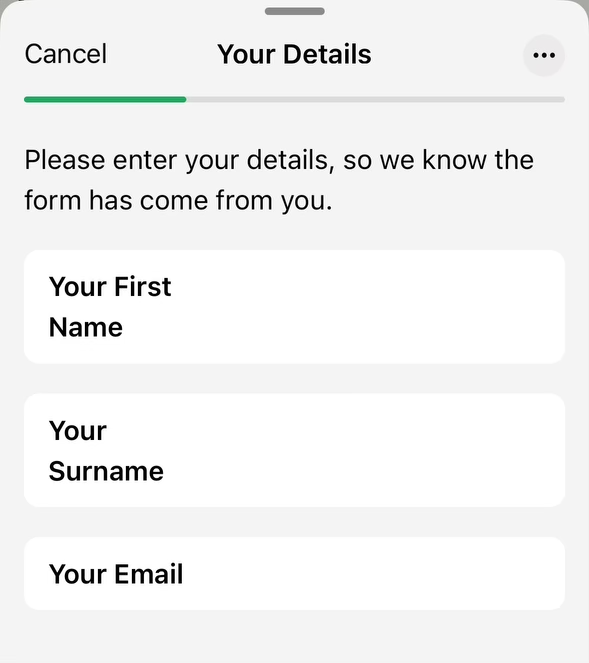
WhatsApp flow is basically a form within WhatsApp that you can use to do lots of different things!
A general rule of thumb would be to force anyone to register with you before contacting you. You could get super advanced here and build an API call into a CRM for a unique value or log in information – however for this guide we are going to keep it simple.
Once the form is built, you could then save the data in a CRM or simple Google Sheet, so we know that WhatsApp number is associated with that person. Then the next time they contact you can start the response with “Hey Josh 👋” instead of requesting them to complete the form again.
The Concept
Let’s just check we are super clear at this stage:
- WhatsApp flows are forms within WhatsApp.
- We can take that data and do some clever stuff with it.
- This is way better than manually replying to messages, as an individual as you have scale. Think about if you were to use a ‘personal WhatsApp number’ to manage your business enquiries. What if:
- They are off sick.
- They are on holiday.
- They lose their phone.
- They leave.
- The phone gets stolen.
- We now know that we need a business WhatsApp number. Please ensure you’ve got this.
- Once you’ve got your business phone number, please ensure it’s registered with meta.
- Then make sure you’ve set your Webhook up with make.com.
WhatsApp Template vs WhatsApp Response 🤔
WhatsApp Template – The main use case for this is initiating a conversation with a user. For example – sending out a marketing message or a feedback request. You can also use this option to reply once a user messages you as well.
WhatsApp Response – This can only be used to respond to a user. You couldn’t use this to directly contact a user.
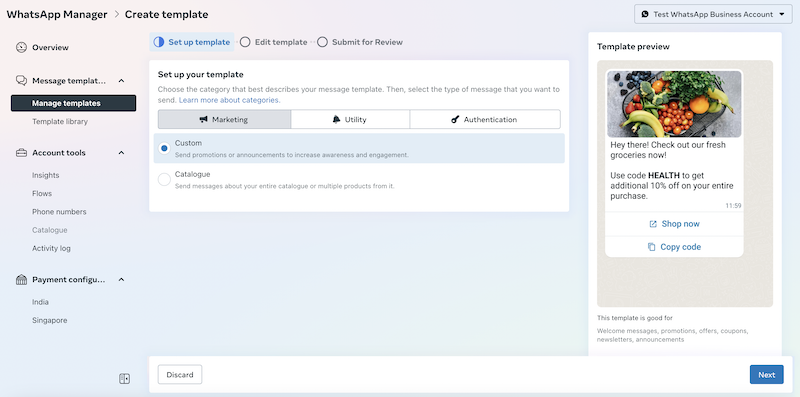
For a WhatsApp template – we have to set this up in the back end of Meta.
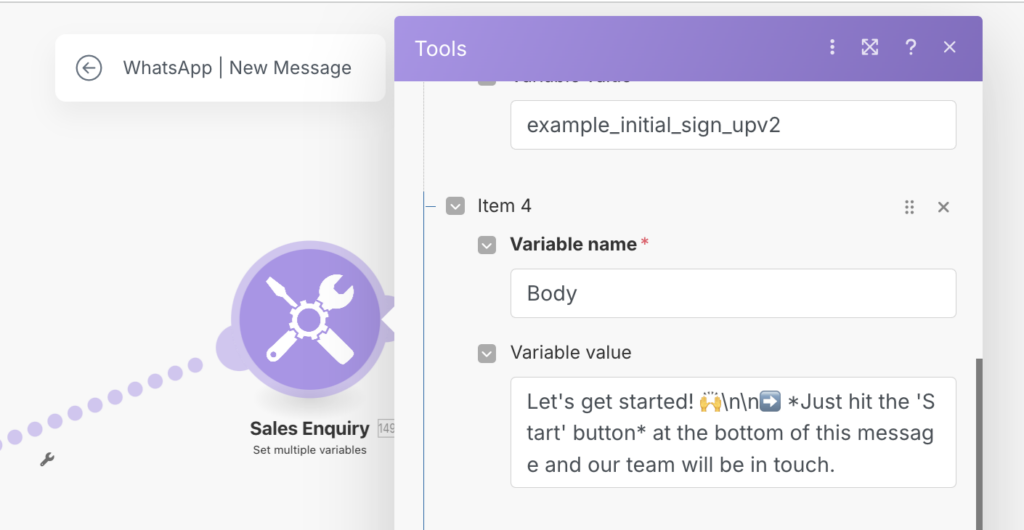
For a WhatsApp response, we can set this up in make.com or your own API.
Setting up a WhatsApp template with a Flow
It’s always great to start with a template message and integrate the flow, just so you can check you’ve fully understood how it works.
Step 1: Access WhatsApp Business Manager
To create a WhatsApp template with a flow, start by heading to WhatsApp Templates.
- Click on Create Template and choose a category (e.g., Utility, Marketing, or Authentication).
- Create the template message, completing the required fields.
- You can use ‘variables’ which you can then query in make.com and fill with say a first_name or other field.
- Please note templates do have to be approved by meta before they can be sent.
Step 2: Create a new flow
You can access flows from another tab within the business dashboard, but also whilst in template setup, which is super handy.
- Click create flow.
- Choose custom form or use a pre made template (I prefer custom form).
- Create your fields and screen titles (the builder is really interactive and simple).
- Remember to include validation for certain fields.
- Definitely use the ‘screen’ feature to help the user interaction with the form so you don’t have lots of fields on one page!
Step 3: Submit for approval.
- Click Submit for review.
- WhatsApp typically approves templates within 24 hours.
- Ensure your template follows WhatsApp’s Business Policy to avoid rejection.
Make.com WhatsApp Flow Setup
Let’s head on over to make.com and set everything up! Firstly, we are assuming that you are all setup and receiving data when someone messages your number. If you aren’t please see this guide.
Important – please also note your permanent access token.
Step 1: Import the template scenario
I’ve added a template scenario for you to download here so you have somewhere to start! You’ll need to import this by pressing the ‘import scenario’ button on a blank scenario.
Step 2: Google Sheets Spreadsheet
Set up a basic google sheets spreadsheet with Number, First Name, Surname, Email and Completed Sign Up Form. Map this spreadsheet to the initial spreadsheet in the make.com scenario.
This will serve as a basic database (you can use your own CRM or other platform to store your data) that we can query when someone messages us.
The concept here is that someone must complete a sign up form before they can then proceed to the next stage.
Step 3: Your Permanent Access Token
Add your permanent access token to the set variable module. This will provide the authorisation required to send WhatsApp messages.
Step 4: Understanding a flow token
A Flow Token is a unique identifier that connects the specific WhatsApp flow that the user has completed. Think about it as the way that you know what form a user has completed.
Step 5: Completing the set multiple variables module
Now you can explore the multiple variables module. This should be pretty self explanatory, but is the way messages are sent back to the user. You can customise this based on your setup and what you want to send back to the user.
Step 6: Handling the response from the user
Now we know when the user completes the form, we want to do some clever stuff with that data.
- Note the filter ‘message type = interactive’ in the first router. This will then send the message down a different path.
- You’ll also note the filter which shows that the user hasn’t completed the welcome form.
- Then also notice the filter with the ‘flow token’ – this is how we know the user has completed a ‘sign up form’ (or any other token of your choice).
- Now we can just use a normal make.com WhatsApp module to reply to the message saying ‘thanks for signing up’.
- Finally, we add that data to the google sheets file, so next time they message we know they’ve already completed the sign up process and we can just query the first_name field to reply directly to the user, making it feel ‘super personalised’.
Step 7 (Alternative): Using a response message as apposed to a template message
One of my preferred options is to just use a ‘response message’ as apposed to a template message, so you don’t have to go through the laborious approval process with meta. To do this – note the ‘Example > Individual Message’ HTTP module. In here, you’ll find the fields mapped and you can just edit the body text in the set variables module.
Step 8 (Alternative): Creating a flow without a template
If you are confident creating JSON, then I would suggest using my example JSON as a starting point.
You can then just build out a WhatsApp flow, utilising meta’s WhatsApp flow builder. Then all you need to do is query this in your set variables module (Flow Name, Flow Token, Flow ID, Screen and Button Text). This allows you to reply to messages without the need to use the template builder.
The Possibilities of WhatsApp Flows ⭐️
The premise behind this guide is to get you to think: “Hey this is pretty cool, here’s how we could link it in-to what we do!”
If you are already thinking this, then great! If not, then let’s explore some of the things you can do…
🚀 Automating Customer Support
Businesses can automate FAQs, ticketing systems, and chatbot interactions, reducing response times and improving customer satisfaction. Whether answering common inquiries or routing complex issues to live agents, WhatsApp Flows ensure a seamless experience.
📅 Appointment Scheduling & Bookings
Businesses can automate appointment scheduling, reservations, and event bookings directly in WhatsApp. Users can select available time slots, receive confirmation messages, and even reschedule – all without leaving the chat.
🛍️ E-commerce & Order Management
WhatsApp Flows can simplify product browsing, order placement, and tracking. Customers can explore products, check availability, and complete purchases with integrated payment options – making WhatsApp a powerful sales channel.
📲 Lead Generation & Sales Automation
Automate lead capture and qualification by guiding users through a structured conversation. Collect customer details, segment leads based on responses, and seamlessly integrate the data into your CRM for follow-ups.
🔔 Notifications & Reminders
Set up automated reminders for appointments, payments, or important deadlines. Businesses can send timely notifications, reducing missed appointments and improving engagement rates.
🌍 Multi-Language & Global Reach
With WhatsApp’s global user base, businesses can implement multi-language flows to cater to diverse audiences, ensuring a personalised experience no matter where customers are.
Integrating AI to WhatsApp Flows
I’m sure by now you are thinking… we need some AI involved in this process. By integrating AI-driven chatbots, NLP (Natural Language Processing), and automation tools, businesses can provide highly personalised and dynamic customer experiences.
Why Add AI to WhatsApp Flows?
By incorporating AI into WhatsApp Flows, businesses can:
- Automate Conversations – AI chatbots can handle inquiries 24/7 without human intervention.
- Understand Customer Intent – NLP-powered AI can interpret messages, making responses more relevant.
- Personalize Interactions – AI can analyze customer history to provide tailored recommendations.
- Improve Response Accuracy – AI models ensure the right answers are provided based on user queries.
- Scale Customer Support – AI-powered WhatsApp Flows allow businesses to manage thousands of interactions simultaneously.
AI-Powered Chatbots in WhatsApp Flows
AI chatbots can be integrated into WhatsApp Flows to guide customers through structured conversations. Whether it’s answering FAQs, assisting with orders, or collecting feedback, AI enhances WhatsApp automation by making interactions more natural and efficient.
Integrating this in make.com
This is why I love make.com – you can add this to your processes very quickly and then edit it as your business develops and changes. Just drag a ChatGPT module into your scenario and fire it up!
Conclusion
WhatsApp Flows, when integrated with Make.com, offer an incredible opportunity to automate customer interactions, streamline workflows, and improve engagement at scale. Whether you’re using them for customer support, lead generation, appointment scheduling, or order management, WhatsApp Flows help businesses operate more efficiently while providing a seamless experience for users.
If you haven’t already, now is the perfect time to explore the potential of WhatsApp Flows. With the right setup and automation strategy, you can turn WhatsApp into a powerful communication channel that works around the clock for your business without the need for reliance on a person or device.
So, what’s next? Start experimenting with WhatsApp Flows today, download the templates provided, and get your first automated workflow up and running. The future of customer interaction is here-make sure your business is ready for it! 🚀
Tagged
Last updated
Category
AutomationLikes
More posts
You might also enjoy
Automation
Make.com map() Function: Syntax, Examples and parseNumber()
Learn how Make.com’s map() function extracts and filters array values, how to combine it with join(), first() and max(), and when to use parseNumber().
JoshuaOctober 1, 2025
Automation
Free Make.com Reddit Scraper Blueprint
Download a free Make.com Reddit scraper blueprint that uses public RSS, cleans post data, filters ideas with AI and sends results to your content workflow.
JoshuaSeptember 17, 2025
Automation
Tracking Clicks Made Simple for your Business (and other ideas)!
Tracking Clicks for Business is the first step to smarter marketing. Grab free downloads and build your own easy metrics dashboard today!
JoshuaAugust 24, 2025
Star Rating
5.0/5 from 1 rating
Comments
No comments yet - start the conversation.